


Photosynthetica 2023, 61(2):215-224 | DOI: 10.32615/ps.2023.009
Impact of additional green light and deficit in cryptochrome 1 on photosynthetic activity and pro-/antioxidant balance in Arabidopsis thaliana
- 1 Institute of Basic Biological Problems, Russian Academy of Sciences, Institutskaya Street 2, 142290 Pushchino, Moscow Region, Russia
- 2 K.A. Timiryazev Institute of Plant Physiology, Russian Academy of Sciences, Botanicheskaya Street 35, 127276 Moscow, Russia
- 3 Faculty of Science, King Abdulaziz University, 21589 Jeddah, Saudi Arabia
- 4 Faculty of Engineering and Natural Sciences, Bahcesehir University, Istanbul, Turkey
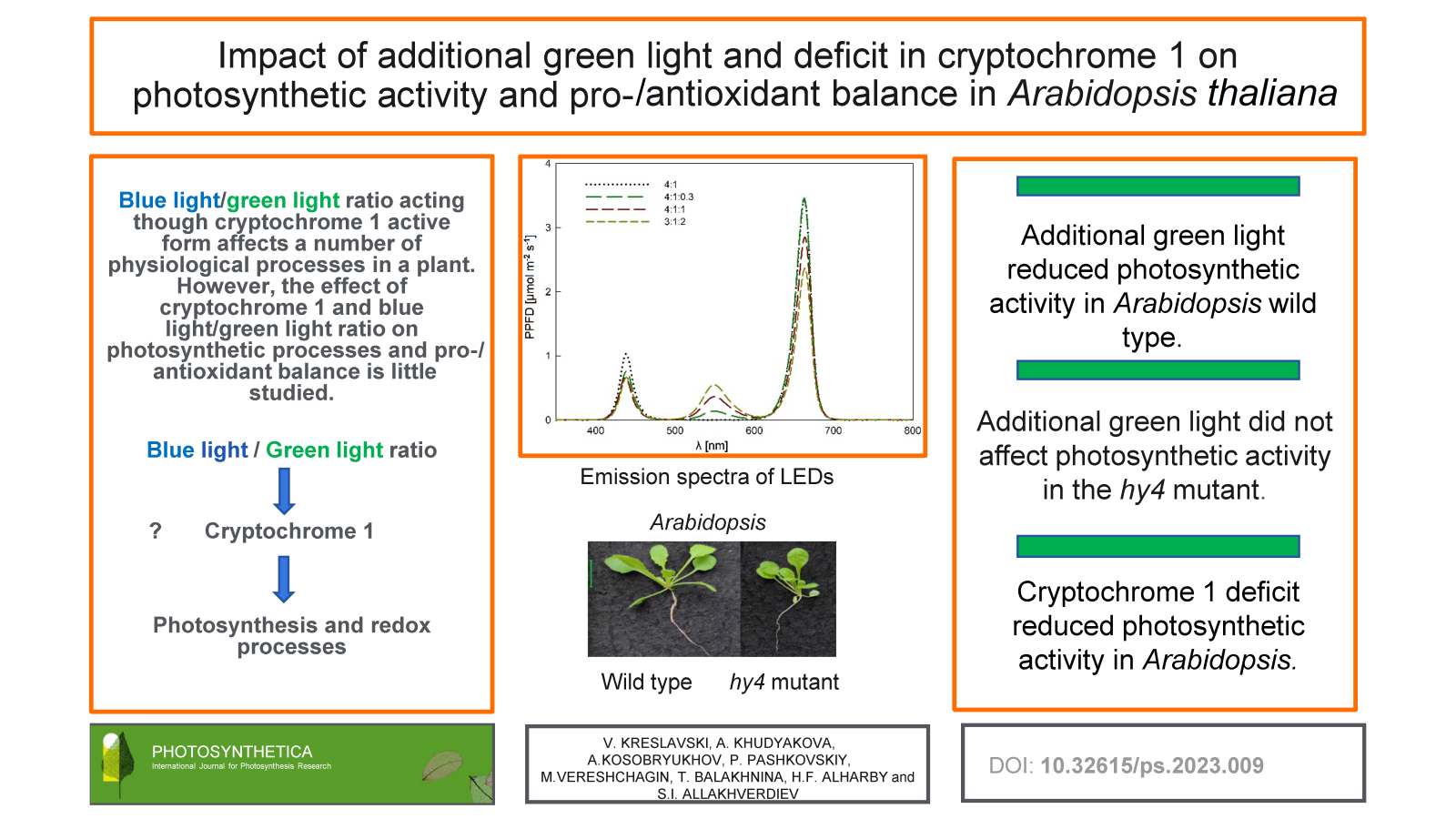
The light spectral composition acting through a set of photoreceptors, such as cryptochromes and phytochromes, plays an important role in maintaining sustainable photosynthesis. An impact of cryptochrome 1 deficiency and additions of green light (GL) against the background of red (RL) and blue (BL) (different ratios of RL:BL:GL) on the activity of the photosynthetic apparatus, the content of photosynthetic pigments, pro-/antioxidant balance, and expression of some genes in the leaves of 23-d-old Arabidopsis thaliana hy4 mutant plants was studied. The deficiency of cryptochrome 1 at RL/BL ratio of 4:1 led to a decrease in the rate of photosynthesis, photosystem II activity, and activity of ascorbate peroxidase and total peroxidase but to an increase in the content of products reacting with thiobarbituric acid. However, in the presence of additional GL, this difference for photosynthetic parameters either decreased or was absent, likely due to a GL-induced decrease in the content of active cryptochrome.
Additional key words: cryptochrome mutant; photosynthesis; photosystem II.
Received: February 4, 2023; Revised: March 3, 2023; Accepted: March 14, 2023; Prepublished online: March 24, 2023; Published: June 6, 2023 Show citation
| ACS | AIP | APA | ASA | Harvard | Chicago | Chicago Notes | IEEE | ISO690 | MLA | NLM | Turabian | Vancouver |

References
- Balakhnina T.I., Nadezhkina E.S.: Effect of selenium on growth and antioxidant capacity of Triticum aestivum L. during development of lead-induced oxidative stress. - Russ. J. Plant Physiol. 64: 215-223, 2017.
 Go to original source...
 - Bouly J.-P., Schleicher E., Dionisio-Sese M. et al.: Cryptochrome blue light photoreceptors are activated through interconversion of flavin redox states. - J. Biol. Chem. 282: 9383-9391, 2007. Go to original source...
- Cao K., Yu J., Xu D. et al.: Exposure to lower red to far-red light ratios improve tomato tolerance to salt stress. - BMC Plant Biol. 18: 92, 2018. Go to original source...
- Chaves I., Pokorny R., Byrdin M. et al.: The cryptochromes: blue light photoreceptors in plants and animals. - Annu. Rev. Plant Biol. 62: 335-364, 2011. Go to original source...
- D'Amico-Damião V., Carvalho R.F.: Cryptochrome-related abiotic stress responses in plants. - Front. Plant Sci. 9: 1897, 2018. Go to original source...
- Demotes-Mainard S., Péron T., Corot A. et al.: Plant responses to red and far-red lights, applications in horticulture. - Environ. Exp. Bot. 121: 4-21, 2016. Go to original source...
- Fantini E., Sulli M., Zhang L. et al.: Pivotal roles of cryptochromes 1a and 2 in tomato development and physiology. - Plant Physiol. 179: 732-748, 2019. Go to original source...
- Folta K.M., Maruhnich S.A.: Green light: a signal to slow down or stop. - J. Exp. Bot. 58: 3099-3111, 2007. Go to original source...
- Giliberto L., Perrotta G., Pallara P. et al.: Manipulation of the blue light photoreceptor cryptochrome 2 in tomato affects vegetative development, flowering time, and fruit antioxidant content. - Plant Physiol. 137: 199-208, 2005. Go to original source...
- Goltsev V.N., Kalaji H.M., Paunov M. et al.: Variable chlorophyll fluorescence and its use for assessing physiological condition of plant photosynthetic apparatus. - Russ. J. Plant Physiol. 63: 869-893, 2016. Go to original source...
- Kim H.-H., Goins G.D., Wheeler R.M., Sager J.C.: Green-light supplementation for enhanced lettuce growth under red- and blue-light-emitting diodes. - HortScience 39: 1617-1622, 2004. Go to original source...
- Kleine T., Kindgren P., Benedict C. et al.: Genome-wide gene expression analysis reveals a critical role for CRYPTOCHROME1 in the response of Arabidopsis to high irradiance. - Plant Physiol. 144: 1391-1406, 2007. Go to original source...
- Kolosova N., Miller B., Ralph S. et al.: Isolation of high-quality RNA from gymnosperm and angiosperm trees. - Biotechniques 36: 821-824, 2004. Go to original source...
- Kreslavski V.D., Carpentier R., Klimov V.V., Allakhverdiev S.I.: Transduction mechanisms of photoreceptor signals in plant cells. - J. Photoch. Photobio. C 10: 63-80, 2009. Go to original source...
- Kreslavski V.D., Lankin A.V., Vasilyeva G.K. et al.: Effects of polyaromatic hydrocarbons on photosystem II activity in pea leaves. - Plant Physiol. Bioch. 81: 135-142, 2014. Go to original source...
- Kreslavski V.D., Strokina V.V., Khudyakova A.Yu. et al.: Effect of high-intensity light and UV-B on photosynthetic activity and the expression of certain light-responsive genes in A. thaliana phyA and phyB mutants. - BBA-Bioenergetics 1862: 148445, 2021. Go to original source...
- Kreslavski V.D., Strokina V.V., Pashkovskiy P.P. et al.: Deficiencies in phytochromes A and B and cryptochrome 1 affect the resistance of the photosynthetic apparatus to high-intensity light in Solanum lycopersicum. - J. Photoch. Photobio. B 210: 111976, 2020. Go to original source...
- Li L., Tong Y.X., Lu J.L. et al.: Morphology, photosynthetic traits, and nutritional quality of lettuce plants as affected by green light substituting proportion of blue and red light. - Front. Plant Sci. 12: 627311, 2021. Go to original source...
- Lichtenthaler H.K.: Chlorophylls and carotenoids: pigments of photosynthetic biomembranes. - Method. Enzymol. 148: 350-382, 1987. Go to original source...
- Lin C., Todo T.: The cryptochromes. - Genome Biol. 6: 220, 2005. Go to original source...
- Lin C., Yang H., Guo H. et al.: Enhancement of blue-light sensitivity of Arabidopsis seedlings by a blue light receptor cryptochrome 2. - P. Natl. Acad. Sci. USA 95: 2686-2690, 1998. Go to original source...
- Liu B., Yang Z., Gomez A. et al.: Signaling mechanisms of plant cryptochromes in Arabidopsis thaliana. - J. Plant Res. 129: 137-148, 2016. Go to original source...
- Liu H., Liu B., Zhao C. et al.: The action mechanisms of plant cryptochromes. - Trends Plant Sci. 16: 684-691, 2011. Go to original source...
- Mirecki R.M., Teramura A.H.: Effect of ultraviolet B irradiance on soybean: V. The dependence of plant sensitivity on photosynthesis flux density during and after leaf expansion. - Plant Physiol. 74: 475-480, 1984. Go to original source...
- Nakano Y., Asada K.: Hydrogen peroxide is scavenged by ascorbate-specific peroxidase in spinach chloroplasts. - Plant Cell Physiol. 22: 867-880, 1981. Go to original source...
- Pashkovskiy P.P., Vankova R., Zlobin I.E. et al.: Comparative analysis of abscisic acid levels and expression of abscisic acid-related genes in Scots pine and Norway spruce seedlings under water deficit. - Plant Physiol. Bioch. 140: 105-112, 2019. Go to original source...
- Re R., Pellegrini N., Proteggente A. et al.: Antioxidant activity applying an improved ABTS radical cation decolorization assay. - Free Radical Bio. Med. 26: 1231-1237, 1999. Go to original source...
- Sellaro R., Crepy M., Trupkin S.A. et al.: Cryptochrome as a sensor of the blue/green ratio of natural radiation in Arabidopsis. - Plant Physiol. 154: 401-409, 2010. Go to original source...
- Şen A.: Oxidative stress studies in plant tissue culture. - In: El-Missiry M.A. (ed.): Antioxidant Enzyme. Pp. 59-88. InTechOpen, 2012. Go to original source...
- Shmarev A.N., Shirshikova G.N., Lyubimov V.Yu., Kreslavski V.D.: Effect of phytochrome deficit on activity of ascorbate peroxidase and phenylalanine ammonia-lyase and expression of genes APX1, tAPX, sAPX, and PAL in the leaves of Arabidopsis thaliana plants exposed to UV-A and red light. - Russ. J. Plant Physiol. 67: 953-959, 2020. Go to original source...
- Smith H.L., McAusland L., Murchie E.H.: Don't ignore the green light: Exploring diverse roles in plant processes. - J. Exp. Bot. 68: 2099-2110, 2017. Go to original source...
- Stirbet A., Govindjee: On the relation between the Kautsky effect (chlorophyll a fluorescence induction) and photosystem II: basics and applications of the OJIP fluorescence transient. - J. Photoch. Photobio. B 104: 36-57, 2011. Go to original source...
- Voitsekhovskaja O.V.: Phytochromes and other (photo)receptors of information in plants. - Russ. J. Plant Physiol. 66: 351-364, 2019. Go to original source...
- Wang Y., Folta K.M.: Contributions of green light to plant growth and development. - Am. J. Bot. 100: 70-78, 2013. Go to original source...
- Yang H.-Q., Wu Y.-J., Tang R.-H. et al.: The C termini of Arabidopsis cryptochromes mediate a constitutive light response. - Cell 103: 815-827, 2000. Go to original source...
- Zhang T., Folta K.M.: Green light signaling and adaptive response. - Plant Signal. Behav. 7: 75-78, 2012. Go to original source...
- Zhang Y., Kaiser E., Zhang Y. et al.: Red/blue light ratio strongly affects steady-state photosynthesis, but hardly affects photosynthetic induction in tomato (Solanum lycopersicum). -Physiol. Plantarum 167: 144-158, 2019. Go to original source...