


Photosynthetica 2025, 63(1):1-9 | DOI: 10.32615/ps.2024.043
The resistance of Solanum lycopersicum photosynthetic apparatus to high-intensity blue light is determined mainly by the cryptochrome 1 content
- 1 Institute of Basic Biological Problems, Russian Academy of Sciences, 142290 Pushchino, Russia
- 2 K.A. Timiryazev Institute of Plant Physiology, Russian Academy of Sciences, 127276 Moscow, Russia
- 3 Faculty of Engineering and Natural Sciences, Bahcesehir University, Istanbul, Turkey
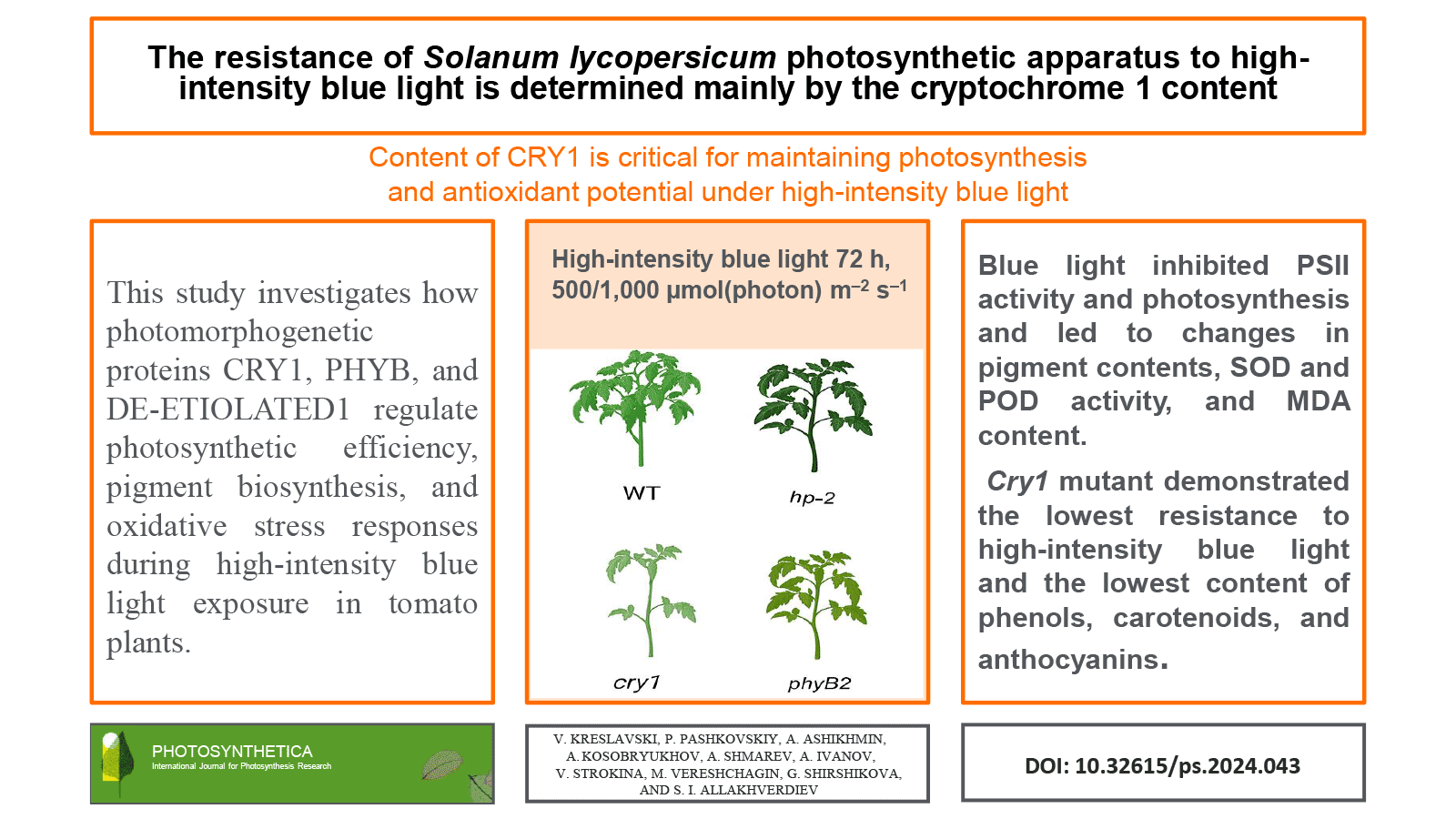
The effects of deficiency of cryptochrome 1 (CRY1), phytochrome B2 (phyB2) and the photoreceptor signalling DET-1 protein (hp-2 mutant) on photosynthesis and pro-/antioxidant balance in Solanum lycopersicum exposed to high-intensity blue light [HIBL, 72 h, 500/1,000 μmol(photon) m-2 s-1] were studied. Noticeable photoinhibition of photosynthesis and PSII was found in all these variants. However, the greatest decrease in photosynthesis and PSII activity was observed in the cry1 mutant. The difference among the other options was less pronounced. This low resistance of the cry1 mutant to HIBL is associated with reduced photosynthetic pigments, phenols, and anthocyanins. It appears that under HIBL, CRY1 and, to a lesser extent, phyB2 are required to maintain photosynthesis and antioxidant defence, mitigating blue light-induced oxidative stress. This study expands our understanding of the defence functions of CRY1 and highlights its importance in adapting the photosynthetic apparatus to HIBL.
Additional key words: blue irradiation; Chl a fluorescence; high irradiance; photoinhibition; photosynthetic activity; tomato.
Received: August 26, 2024; Revised: December 3, 2024; Accepted: December 27, 2024; Prepublished online: January 17, 2025; Published: March 27, 2025 Show citation
| ACS | AIP | APA | ASA | Harvard | Chicago | Chicago Notes | IEEE | ISO690 | MLA | NLM | Turabian | Vancouver |

References
- Abramova A., Vereshchagin M., Kulkov L. et al.: Potential role of phytochromes A and B and cryptochrome 1 in the adaptation of Solanum lycopersicum to UV-B radiation. - Int. J. Mol. Sci. 24: 13142, 2023.
 Go to original source...
 - Aro E.-M., Virgin I., Andersson B.: Photoinhibition of Photosystem II. Inactivation, protein damage and turnover. - BBA-Bioenergetics 1143: 113-134, 1993. Go to original source...
- Ashikhmin A., Bolshakov M., Pashkovskiy P. et al.: The adaptive role of carotenoids and anthocyanins in Solanum lycopersicum pigment mutants under high irradiance. - Cells 12: 2569, 2023. Go to original source...
- Ashikhmin A., Pashkovskiy P., Kosobryukhov A. et al.: The role of pigments and cryptochrome 1 in the adaptation of Solanum lycopersicum photosynthetic apparatus to high-intensity blue light. - Antioxidants 13: 605, 2024. Go to original source...
- Bhutta M.A., Bibi A., Ahmad N.H. et al.: Molecular mechanisms of photoinhibition in plants: A review. - Sarhad J. Agric. 39: 340-345, 2023. Go to original source...
- Chaves I., Pokorny R., Byrdin M. et al.: The cryptochromes: blue light photoreceptors in plants and animals. - Annu. Rev. Plant Biol. 62: 335-364, 2011. Go to original source...
- Foyer C.H., Ruban A.V., Noctor G.: Viewing oxidative stress through the lens of oxidative signalling rather than damage. -Biochem. J. 474: 877-883, 2017. Go to original source...
- Goltsev V.N., Kalaji H.M., Paunov M. et al.: Variable chlorophyll fluorescence and its use for assessing physiological condition of plant photosynthetic apparatus. - Russ. J. Plant Physiol. 63: 869-893, 2016. Go to original source...
- Gupta A.S., Webb R.P., Holaday A.S., Allen R.D.: Overexpression of superoxide dismutase protects plants from oxidative stress (induction of ascorbate peroxidase in superoxide dismutase-overexpressing plants). - Plant Physiol. 103: 1067-1073, 1993. Go to original source...
- Jiao Y., Yang H., Ma L. et al.: A genome-wide analysis of blue-light regulation of Arabidopsis transcription factor gene expression during seedling development. - Plant Physiol. 133: 1480-1493, 2003. Go to original source...
- Kalaji H.M., Jajoo A., Oukarroum A. et al.: Chlorophyll a fluorescence as a tool to monitor physiological status of plants under abiotic stress conditions. - Acta Physiol. Plant. 38: 102, 2016. Go to original source...
- Khudyakova A., Kreslavski V., Kosobryukhov A. et al.: Effect of cryptochrome 1 deficiency and spectral composition of light on photosynthetic processes in A. thaliana under high-intensity light exposure. - Photosynthetica 62: 71-78, 2024. Go to original source...
- Kleine T., Kindgren P., Benedict C. et al.: Genome-wide gene expression analysis reveals a critical role for CRYPTOCHROME1 in the response of Arabidopsis to high irradiance. - Plant Physiol. 144: 1391-1406, 2007. Go to original source...
- Klughammer C., Schreiber U.: Saturation pulse method for assessment of energy conversion in PS I. - PAM Appl. Notes 1: 11-14, 2008.
- Kramer D.M., Johnson G., Kiirats O., Edwards G.E.: New fluorescence parameters for the determination of QA redox state and excitation energy fluxes. - Photosynth. Res. 79: 209-218, 2004. Go to original source...
- Kreslavski V.D., Lankin A.V., Vasilyeva G.K. et al.: Effects of polyaromatic hydrocarbons on photosystem II activity in pea leaves. - Plant Physiol. Biochem. 81: 135-142, 2014. Go to original source...
- Kreslavski V.D., Los D.A., Schmitt F.-J. et al.: The impact of the phytochromes on photosynthetic processes. - BBA-Bioenergetics 1859: 400-408, 2018. Go to original source...
- Levin I., De Vos C.H.R., Tadmor Y. et al.: High pigment tomato mutants - more than just lycopene (a review). - Israel J. Plant Sci. 54: 179-190, 2006. Go to original source...
- Lichtenthaler H.K.: Chlorophylls and carotenoids: pigments of photosynthetic biomembranes. - Method. Enzymol. 148: 350-382, 1987. Go to original source...
- Liu C.-C., Chi C., Jin L.-J. et al.: The bZip transcription factor HY5 mediates CRY1a-induced anthocyanin biosynthesis in tomato. - Plant Cell Environ. 41: 1762-1775, 2018. Go to original source...
- Liu Y., Roof S., Ye Z. et al.: Manipulation of light signal transduction as a means of modifying fruit nutritional quality in tomato. - PNAS 101: 9897-9902, 2004. Go to original source...
- Maehly A.C., Chance B.: The assay of catalases and peroxidases. -In: Glick D. (ed.): Methods of Biochemical Analysis. Pp. 357-424. Interscience Publishers, New York 1954. Go to original source...
- Mustilli A.C., Fenzi F., Ciliento R. et al.: Phenotype of the tomato high pigment-2 mutant is caused by a mutation in the tomato homolog of DEETIOLATED1. - Plant Cell 11: 145-157, 1999. Go to original source...
- Ponnu J., Hoecker U.: Signalling mechanisms by Arabidopsis cryptochromes. - Front. Plant Sci. 13: 844714, 2022. Go to original source...
- Powles S.B.: Photoinhibition of photosynthesis induced by visible light. - Annu. Rev. Plant Biol. 35: 15-44, 1984. Go to original source...
- Ruban A.V.: Nonphotochemical chlorophyll fluorescence quenching: mechanism and effectiveness in protecting plants from photodamage. - Plant Physiol. 170: 1903-1916, 2016. Go to original source...
- Schreiber U.: Pulse-amplitude-modulation (PAM) fluorometry and saturation pulse method: An overview. - In: Papageorgiou G.C., Govindjee (ed.): Chlorophyll a Fluorescence: A Signature of Photosynthesis. Advances in Photosynthesis and Respiration. Pp. 279-319. Springer, Dordrecht 2004. Go to original source...
- Singleton V.L., Rossi J.A.: Colorimetry of total phenolics with phosphomolybdic-phosphotungstic acid reagents. - Am. J. Enol. Vitic. 16: 144-158, 1965. Go to original source...
- Solovchenko A.: Buildup of screening pigments and resistance of plants to photodamage. - In: Solovchenko A. (ed.): Photoprotection in Plants: Optical Screening-Based Mechanisms. Springer Series in Biophysics. Pp. 143-163. Springer, Berlin-Heidelberg 2010. Go to original source...
- Solovchenko A.E., Merzlyak M.N.: Screening of visible and UV radiation as a photoprotective mechanism in plants. - Russ. J. Plant Physiol. 55: 719-737, 2008. Go to original source...
- Stetsenko L.A., Pashkovskiy P.P., Voloshin R.A. et al.: Role of anthocyanin and carotenoids in the adaptation of the photosynthetic apparatus of purple- and green-leaved cultivars of sweet basil (Ocimum basilicum) to high-intensity light. - Photosynthetica 58: 890-901, 2020. Go to original source...
- Su J., Liu B., Liao J. et al.: Coordination of cryptochrome and phytochrome signals in the regulation of plant light responses. - Agronomy 7: 25, 2017. Go to original source...
- Tyystjärvi E.: Photoinhibition of Photosystem II. - In: Kwang W.J. (ed.): International Review of Cell and Molecular Biology. Vol. 300. Pp. 243-303. Academic Press, Amsterdam 2013. Go to original source...
- Wang X., Wang Q., Han Y.-J. et al.: A CRY-BIC negative-feedback circuitry regulating blue light sensitivity of Arabidopsis. - Plant J. 92: 426-436, 2017. Go to original source...
- Zavafer A., Mancilla C.: Concepts of photochemical damage of Photosystem II and the role of excessive excitation. - J. Photoch. Photobio. C 47: 100421, 2021. Go to original source...
- Zhang L.-X., Li S.-X., Zhang H., Liang Z.-S.: Nitrogen rates and water stress effects on production, lipid peroxidation and antioxidative enzyme activities in two maize (Zea mays L.) genotypes. - J. Agron. Crop Sci. 193: 387-397, 2007. Go to original source...