


Photosynthetica 2024, 62(4):361-371 | DOI: 10.32615/ps.2024.039
Ascorbic acid is involved in melatonin-induced salinity tolerance of maize (Zea mays L.) by regulating antioxidant and photosynthetic capacities
- 1 College of Agronomy, Specialty Corn Institute, Shenyang Agricultural University, 110866 Shenyang, Liaoning Province, China
- 2 Affiliated Experimental Field, Shenyang Agricultural University, 110866 Shenyang, Liaoning Province, China
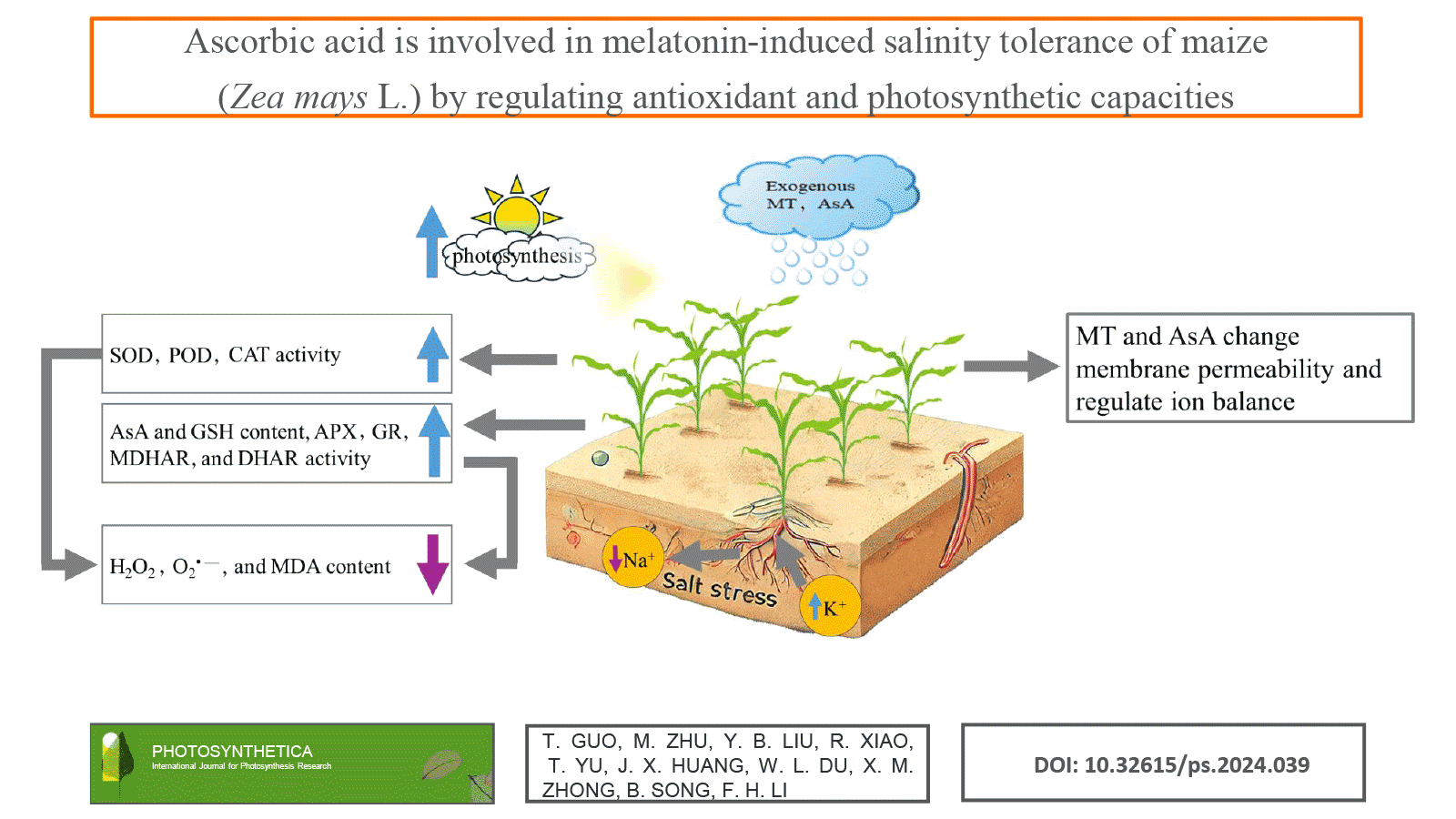
Melatonin (MT), an indole compound, can boost plant growth under abiotic stress conditions. This experiment aims to elucidate the synergistic effect of MT and ascorbic acid (AsA) in mitigating salinity stress by assessing the photosynthetic and antioxidant capacity of the maize inbred lines H123 and W961. The results indicated that exogenous MT and AsA significantly improved photosynthetic efficiency and biomass of maize under salinity stress. Additionally, exogenous MT and AsA also improved antioxidant enzyme activities, promoted regeneration of AsA and GSH, decreased reactive oxygen species contents, suppressed Na+ accumulation, and improved the K+/Na+ ratio of maize seedlings. Additionally, the AsA inhibitor lycorine decreased the endogenous content of AsA and eliminated the positive effects of MT, while the MT inhibitor p-chlorophenyl alanine (CPA) reduced the endogenous content of MT, which could not eliminate the promoting effects of AsA. The results suggested that AsA may act as a downstream signal involved in the regulatory effects of MT on maize under salinity stress.
Additional key words: AsA-GSH cycle; ascorbic acid; ionic homeostasis; maize; melatonin; salinity stress.
Received: July 15, 2024; Revised: November 8, 2024; Accepted: November 12, 2024; Prepublished online: December 3, 2024; Published: December 19, 2024 Show citation
| ACS | AIP | APA | ASA | Harvard | Chicago | Chicago Notes | IEEE | ISO690 | MLA | NLM | Turabian | Vancouver |

Supplementary files
| Download file | Guo_3130_supplement.docx File size: 1.25 MB |
References
- Abedi T., Pakniyat H.: Antioxidant enzymes changes in response to drought stress in ten cultivars of oilseed rape (Brassica napus L.). - Czech J. Genet. Plant Breed. 46: 27-34, 2010.
 Go to original source...
 - Ahmad P.A., Ahanger M.A., Alam P. et al.: Silicon (Si) supplementation alleviates NaCl toxicity in mung bean [Vigna radiata (L.) Wilczek] through the modifications of physio-biochemical attributes and key antioxidant enzymes. - J. Plant Growth Regul. 38: 70-82, 2019. Go to original source...
- Akhlaghi H., Mahdavi B., Rezaei H.: Characterization of chemical composition and antioxidant properties of Trachyspermum ammi seed as a potential medicinal plant. - J. Chem. Health Risks 4: 9-16, 2014.
- Alscher R.G., Erturk N., Heath L.S.: Role of superoxide dismutases (SODs) in controlling oxidative stress in plants. - J. Exp. Bot. 53: 1331-1341, 2002. Go to original source...
- Altaf M.A., Shahid R., Ren M.-X. et al.: Melatonin alleviates salt damage in tomato seedling: A root architecture system, photosynthetic capacity, ion homeostasis, and antioxidant enzymes analysis. - Sci. Hortic.-Amsterdam 285: 110145, 2021. Go to original source...
- Azeem M., Sultana R., Mahmood A. et al.: Ascorbic and salicylic acids vitalized growth, biochemical responses, antioxidant enzymes, photosynthetic efficiency, and ionic regulation to alleviate salinity stress in Sorghum bicolor. - J. Plant Growth Regul. 42: 5266-5279, 2023. Go to original source...
- Aziz U., Qadir I., Yasin G. et al.: Potential of priming in improving germination, seedling growth and nutrient status of Calotropis procera under salinity. - Pak. J. Bot. 53: 1953-1958, 2021. Go to original source...
- Barzegar T., Fateh M., Razavi F.: Enhancement of postharvest sensory quality and antioxidant capacity of sweet pepper fruits by foliar applying calcium lactate and ascorbic acid. - Sci. Hortic.-Amsterdam 241: 293-303, 2018. Go to original source...
- Bawa G., Feng L., Shi J. et al.: Evidence that melatonin promotes soybean seedlings growth from low-temperature stress by mediating plant mineral elements and genes involved in the antioxidant pathway. - Funct. Plant Biol. 47: 815-824, 2020. Go to original source...
- Bybordi A.: Effect of ascorbic acid and silicium on photosynthesis, antioxidant enzyme activity, and fatty acid contents in canola exposure to salt stress. - J. Integr. Agr. 11: 1610-1620, 2012. Go to original source...
- Cao Y., Liang X., Yin P. et al.: A domestication-associated reduction in K+-preferring HKT transporter activity underlies maize shoot K+ accumulation and salt tolerance. - New Phytol. 222: 301-317, 2018. Go to original source...
- Chen X.J., Zhou Y., Cong Y.D. et al.: Ascorbic acid-induced photosynthetic adaptability of processing tomatoes to salt stress probed by fast OJIP fluorescence rise. - Front. Plant Sci. 12: 594400, 2021. Go to original source...
- Davey M.W., Persiau G., De Bruyn A. et al.: Purification of the alkaloid lycorine and simultaneous analysis of ascorbic acid and lycorine by micellar electrokinetic capillary chromatography. - Anal. Biochem. 257: 80-88, 1998. Go to original source...
- Dubbels R., Reiter R.J., Klenke E. et al.: Melatonin in edible plants identified by radioimmunoassay and by high performance liquid chromatography-mass spectrometry. - J. Pineal Res. 18: 28-31, 1995. Go to original source...
- El-Katony T.M., Deyab M.A., El-Adl M.F., El-Nabway F.M.: The aqueous extract and powder of the brown alga Dictyota dichotoma (Hudson) differentially alleviate the impact of abiotic stress on rice (Oryza sativa L.). - Physiol. Mol. Biol. Pla. 26: 1155-1171, 2020. Go to original source...
- Fu Q., Cao H., Wang L. et al.: Transcriptome analysis reveals that ascorbic acid treatment enhances the cold tolerance of tea plants through cell wall remodeling. - Int. J. Mol. Sci. 24: 10059, 2023. Go to original source...
- Gao H.S., Huang L.Z., Gong Z.J. et al.: Exogenous melatonin application improves resistance to high manganese stress through regulating reactive oxygen species scavenging and ion homeostasis in tobacco. - Plant Growth Regul. 98: 219-233, 2022a. Go to original source...
- Gao Z., Zhang J., Zhang J. et al.: Nitric oxide alleviates salt-induced stress damage by regulating the ascorbate-glutathione cycle and Na+/K+ homeostasis in Nitraria tangutorum Bobr. - Plant Physiol. Biochem. 173: 46-58, 2022b. Go to original source...
- Ghorbani A., Omran V.O.G., Razavi S.M. et al.: Piriformospora indica confers salinity tolerance on tomato (Lycopersicon esculentum Mill.) through amelioration of nutrient accumulation, K+/Na+ homeostasis and water status. - Plant Cell Rep. 38: 1151-1163, 2019. Go to original source...
- Hao L., Chang J.J., Chen H.J. et al.: Exogenous melatonin confers salt stress tolerance to watermelon by improving photosynthesis and redox homeostasis. - Front. Plant Sci. 8: 295, 2017. Go to original source...
- Hasan M.K., Xing Q.-F., Zhou C.-Y. et al.: Melatonin mediates elevated carbon dioxide-induced photosynthesis and thermotolerance in tomato. - J. Pineal Res. 74: e12858, 2023. Go to original source...
- Hasanuzzaman M., Nahar K., Anee T.I., Fujita M.: Exogenous silicon attenuates cadmium-induced oxidative stress in Brassica napus L. by modulating AsA-GSH pathway and glyoxalase system. - Front. Plant Sci. 8: 1061, 2017. Go to original source...
- Hasanuzzaman M., Raihan M.R.H., Alharby H.F. et al.: Foliar application of ascorbic acid and tocopherol in conferring salt tolerance in rapeseed by enhancing K+/Na+ homeostasis, osmoregulation, antioxidant defense, and glyoxalase system. -Agronomy 13: 361, 2023. Go to original source...
- Hassan A., Amjad S.F., Saleem M.H. et al.: Foliar application of ascorbic acid enhances salinity stress tolerance in barley (Hordeum vulgare L.) through modulation of morpho-physio-biochemical attributes, ions uptake, osmo-protectants and stress response genes expression. - Saudi J. Biol. Sci. 28: 4276-4290, 2021. Go to original source...
- Heath R.L., Packer L.: Photoperoxidation in isolated chloroplasts: I. Kinetics and stoichiometry of fatty acid peroxidation. - Arch. Biochem. Biophys. 125: 189-198, 1968. Go to original source...
- Huang J.X., Liu Y.B., Xiao R. et al.: Exogenous melatonin alleviates nicosulfuron toxicity by regulating the growth, photosynthetic capacity, and antioxidative defense of sweet corn seedlings. - Photosynthetica 62: 58-70, 2024. Go to original source...
- Kamran M., Wennan S., Ahmad I. et al.: Application of paclobutrazol affect maize grain yield by regulating root morphological and physiological characteristics under a semi-arid region. - Sci. Rep.-UK 8: 4818, 2018. Go to original source...
- Khan Z., Jan R., Asif S. et al.: Exogenous melatonin induces salt and drought stress tolerance in rice by promoting plant growth and defense system. - Sci. Rep.-UK 14: 1214, 2024. Go to original source...
- Li C., Wang P., Wei Z. et al.: The mitigation effects of exogenous melatonin on salinity-induced stress in Malus hupehensis. - J. Pineal Res. 53: 298-306, 2012. Go to original source...
- Li J., Yang Y., Sun K. et al.: Exogenous melatonin enhances cold, salt and drought stress tolerance by improving antioxidant defense in tea plant (Camellia sinensis (L.) O. Kuntze). - Molecules 24: 1826, 2019. Go to original source...
- Lichtenthaler H.K., Wellburn A.R.: Determinations of total carotenoids and chlorophylls a and b of leaf extracts in different solvents. - Biochem. Soc. T. 11: 591-592, 1983. Go to original source...
- Liu J., Zhang R., Sun Y. et al.: The beneficial effects of exogenous melatonin on tomato fruit properties. - Sci. Hortic.-Amsterdam 207: 14-20, 2016. Go to original source...
- Luo Z., Zhang J., Xiang M. et al.: Exogenous melatonin treatment affects ascorbic acid metabolism in postharvest 'Jinyan' kiwifruit. - Front. Nutr. 9: 1081476, 2022. Go to original source...
- Mittler R.: Abiotic stress, the field environment and stress combination. - Trends Plant Sci. 11: 15-19, 2006. Go to original source...
- Munns R., Tester M.: Mechanisms of salinity tolerance. - Annu. Rev. Plant Biol. 59: 651-681, 2008. Go to original source...
- Munns R., Wallace P.A., Teakle N.L., Colmer T.D.: Measuring soluble ion concentrations (Na+, K+, Cl-) in salt-treated plants. -In: Sunkar R. (ed.): Plant Stress Tolerance. Methods in Molecular Biology. Vol. 639. Pp. 371-382. Humana Press, Totowa 2010. Go to original source...
- Nakano Y., Asada K.: Hydrogen peroxide is scavenged by ascorbate-specific peroxidase in spinach chloroplasts. - Plant Cell Physiol. 22: 867-880, 1981. Go to original source...
- Nie M., Ning N., Chen J. et al.: Melatonin enhances salt tolerance in sorghum by modulating photosynthetic performance, osmoregulation, antioxidant defense, and ion homeostasis. - Open Life Sci. 18: 20220734, 2023. Go to original source...
- Niu J.P., Chen Z., Yu S., Wang Q.: Ascorbic acid regulates nitrogen, energy, and gas exchange metabolisms of alfalfa in response to high-nitrate stress. - Environ. Sci. Pollut. Res. 29: 24085-24097, 2022. Go to original source...
- Noreen S., Sultan M., Akhter M.S. et al.: Foliar fertigation of ascorbic acid and zinc improves growth, antioxidant enzyme activity and harvest index in barley (Hordeum vulgare L.) grown under salt stress. - Plant Physiol. Biochem. 158: 244-254, 2021. Go to original source...
- Okamoto O.K., Pinto E., Latorre L.R. et al.: Antioxidant modulation in response to metal induced oxidative stress in algal chloroplast. - Arch. Environ. Con. Tox. 40: 18-24, 2001. Go to original source...
- Rao M.V., Paliyath G., Ormrod D.P.: Ultraviolet-B- and ozone-induced biochemical changes in antioxidant enzymes of Arabidopsis thaliana. - Plant Physiol. 110: 125-136, 1996. Go to original source...
- Ros-Barceló A., Pomar F., López-Serrano M. et al.: Developmental regulation of the H2O2-producing system and of a basic peroxidase isoenzyme in the Zinnia elegans lignifying xylem. - Plant Physiol. Biochem. 40: 325-332, 2002. Go to original source...
- Sezer İ., Kiremit M.S., Öztürk E. et al.: Role of melatonin in improving leaf mineral content and growth of sweet corn seedlings under different soil salinity levels. - Sci. Hortic.-Amsterdam 288: 110376, 2021. Go to original source...
- Shabala S., Demidchik V., Shabala L. et al.: Extracellular Ca2+ ameliorates NaCl-induced K+ loss from Arabidopsis root and leaf cells by controlling plasma membrane K+-permeable channels. - Plant Physiol. 141: 1653-1665, 2006. Go to original source...
- Shah S.H.A., Wang H., Xu H. et al.: Comparative transcriptome analysis reveals the protective role of melatonin during salt stress by regulating the photosynthesis and ascorbic acid metabolism pathways in Brassica campestris. - Int. J. Mol. Sci. 25: 5092, 2024. Go to original source...
- Siddiqui M.H., Alamri S., Al-Khaishany M.Y. et al.: Exogenous melatonin counteracts NaCl-induced damage by regulating the antioxidant system, proline and carbohydrates metabolism in tomato seedlings. - Int. J. Mol. Sci. 20: 353, 2019. Go to original source...
- Vafadar F., Amooaghaie R., Ehsanzadeh P. et al.: Crosstalk between melatonin and Ca2+/CaM evokes systemic salt tolerance in Dracocephalum kotschyi. - J. Plant Physiol. 252: 153237, 2020. Go to original source...
- Wang C.Y.: Effect of temperature preconditioning on catalase, peroxidase, and superoxide dismutase in chilled zucchini squash. - Postharvest Biol. Tec. 5: 67-76, 1995. Go to original source...
- Wang D.Y., Wang J., Shi S.H. et al.: Exogenous melatonin ameliorates salinity-induced oxidative stress and improves photosynthetic capacity in sweet corn seedlings. - Photosynthetica 59: 327-336, 2021a. Go to original source...
- Wang J., Wang D.Y., Zhu M., Li F.H.: Exogenous 6-benzyladenine improves waterlogging tolerance in maize seedlings by mitigating oxidative stress and upregulating the ascorbate-glutathione cycle. - Front. Plant Sci. 12: 680376, 2021b. Go to original source...
- Wang J., Wang Y.L., Wang D.Y. et al.: Mitigative effect of 6-benzyladenine on photosynthetic capacity and leaf ultrastructure of maize seedlings under waterlogging stress. - Photosynthetica 60: 389-399, 2022. Go to original source...
- Wang Y., Zhao H., Qin H. et al.: The synthesis of ascorbic acid in rice roots plays an important role in the salt tolerance of rice by scavenging ROS. - Int. J. Mol. Sci. 19: 3347, 2018. Go to original source...
- Wang Z., Li Q., Wu W. et al.: Cadmium stress tolerance in wheat seedlings induced by ascorbic acid was mediated by NO signaling pathways. - Ecotox. Environ. Safe. 135: 75-81, 2017. Go to original source...
- Wu X., Khan R., Gao H. et al.: Low light alters the photosynthesis process in cigar tobacco via modulation of the chlorophyll content, chlorophyll fluorescence, and gene expression. - Agriculture 11: 755, 2021. Go to original source...
- Yan R.Y., Liu J.Y., Zhang S.Y., Guo J.: Exogenous melatonin and salicylic acid enhance the drought tolerance of hibiscus (Hibiscus syriacus L.) by regulating photosynthesis and antioxidant system. - J. Soil Sci. Plant Nutr. 24: 497-511, 2024. Go to original source...
- Yin Z., Lu J., Meng S. et al.: Exogenous melatonin improves salt tolerance in tomato by regulating photosynthetic electron flux and the ascorbate-glutathione cycle. - J. Plant Interact. 14: 453-463, 2019. Go to original source...
- Zhan H., Nie X., Zhang T. et al.: Melatonin: a small molecule but important for salt stress tolerance in plants. - Int. J. Mol Sci. 20: 709, 2019. Go to original source...
- Zhang T., Wang Y., Ma X. et al.: Melatonin alleviates copper toxicity via improving ROS metabolism and antioxidant defense response in tomato seedlings. - Antioxidants 11: 758, 2022. Go to original source...
- Zhang Z., Wang J., Zhang R. et al.: The ethylene response factor AtERF98 enhances tolerance to salt through the transcriptional activation of ascorbic acid synthesis in Arabidopsis. - Plant J. 71: 273-287, 2012. Go to original source...
- Zhou R., Cen B., Jiang F. et al.: Reducing the halotolerance gap between sensitive and resistant tomato by spraying melatonin. - Agronomy 12: 84, 2022. Go to original source...